Esc-Clermont Sup de Co
2nd
years, 1st semester
Course :
Corporate finance
Teacher :
André Cabannes
Please write your
name in this box :
Final exam & Answers in blue
December, 2007
3 hours, 20 questions, each worth 5 points. Write
your answers on this document in the blank space below each question.
Question
1: At the end of
its accounting year, and after including year end adjustments, a firm has the
following trial balance:
|
|
Debit |
Credit |
|
Capital |
|
100 |
|
Cash |
10 |
|
|
Opening stocks (IS) |
- |
|
|
Closing stocks (IS) |
|
50 |
|
Closing stocks (BS) |
50 |
|
|
Equipment (fixed
assets) |
50 |
|
|
Mary (supplier) |
|
- |
|
Purchases |
80 |
|
|
Salary |
10 |
|
|
Sales |
|
90 |
|
Steve (client) |
40 |
|
|
Depreciation (IS) |
10 |
|
|
Cumulated deprec. (BS) |
|
10 |
|
Provisions (IS) |
20 |
|
|
Cumulated prov. (BS) |
|
20 |
|
Total |
270 |
270 |
On the following page, establish its Income
Statement, and its Balance sheet.
This
question was treated in the course:
http://www.lapasserelle.com/clermont/corporate_finance/Lesson3/review.htm
1) Profit and loss account
|
|
Debit |
Credit |
|
Sales |
|
90 |
|
Op stocks |
- |
|
|
Purchases |
80 |
|
|
Cl stocks
(IS) |
|
50 |
|
Salary |
10 |
|
|
Dep (IS) |
10 |
|
|
Prov (IS) |
20 |
|
|
P&L |
|
20 |
2) Balance
sheet
Assets
|
|
Debit |
Credit |
|
Equipment |
50 |
|
|
Cum dep |
|
10 |
|
Cl stocks |
50 |
|
|
Clients
(Steve) |
40 |
|
|
Cum
provisions |
|
20 |
|
Cash |
10 |
|
|
Total |
150 |
30 |
Liabilities
|
|
Debit |
Credit |
|
Capital |
|
100 |
|
Cum
P&L |
|
20 |
|
Suppliers
(Mary) |
|
- |
|
Total |
|
120 |
Question
2: Is the asset
side of the balance sheet of a firm the list of all the values today of what the firm owns?
(explain)
No.
The asset side does record what the firm owns, but at acquisition value, which usually
is not the same as the values today. This is particularly true of land assets.
Question
3: A firm sells for 120€, cash, an item recorded
at 90€ in its stocks: show the impact of this operation on the balance sheet.
Cash
increases by 120€
Stocks
decrease by 90€
So
the asset side increases by 30€
And,
on the liability side, this corresponds to an increase of 30€ in the cumulated
profit.
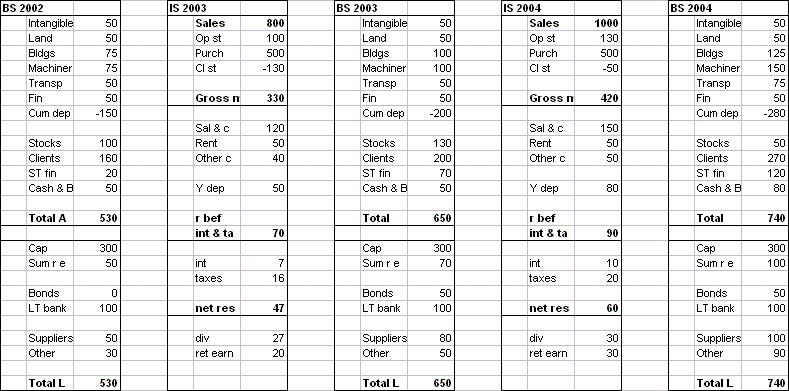
Consider
the following year end documents of a firm. Questions 4 and 5 refer to these
data (example from lesson 3a, section “an example over two years”):

Question
4: What is the ROCE
ratio in 2003 and in 2004 ?
First,
let’s compute the Capital engaged :
CE2002 = 300 + 50 +
0 + 100 = 450
CE2003 = 300 + 70 + 50 + 100 = 520
CE2004 = 300 + 100 + 50 + 100 = 550
The average CE in 2003 is (450 +
520)/2 = 485
The
average CE in 2004 is (550 + 520)/2 = 535
ROCE
= (Result before interest and taxes)/(average CE)
So
ROCE2003
= 70/485 = 14,4%
ROCE2004
= 90/535 = 16,8%
(This
was also a question treated in the course.)
Question
5: What do we mean
by “this firm doesn’t use much its free financing possibilities”?
We
mean that its current liabilities are “too low” compared to its current assets.
In other words, the firm could have higher current liabilities (pay with a
longer delay its suppliers), and reduce the amount of money borrowed from banks
and bond holders, which is costly.
Question
6: What
distinguishes General Accounting and Cost Accounting?
General
accounting is
-
Turned toward the past
-
Legally required
-
Must be published
-
Very global
-
Useless for day to day management
Cost
accounting is the opposite on each criterion. It is
-
Turned toward the future (used to prepare
budgets)
-
Not mandatory
-
It is advisable not to publish it (which would be
very valuable for the competitors)
-
Very detailed
-
Very useful for day to day management (this is
why it is sometimes called “managerial accounting”)
Question
7: What is a cost
center? What is a profit center?
A
cost center is a small part of the activity of the firm where costs of the same
nature are accumulated. Usually they are under the responsibility of a low
ranking manager, or a supervisor. For instance, the “salary costs of welding in
the children bike product line” is a cost center.
A
profit center is a large part of the activity of the firm to which we can
assign a part of the sales, and therefore of the profit (or at least of the
contribution before non allocated costs).
Question
8: A manufacturer
of furniture has the following income statement, split by product lines :
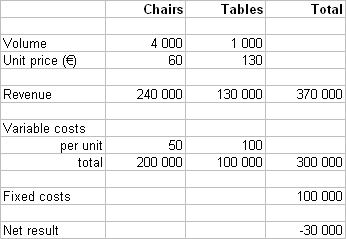
(It looses
money.)
For what
pairs of unit prices would it make money?
Exercise
done in class.
Observe
that the pair of prices (100, 0) turns a profit of zero.
And
so does the pair (0, 400).
In
a two dimensional plan with abscissa, the price of chairs, and ordinate, the
price of tables, draw the line joining these two points.
Any
pair of prices on or above the line, is OK.
Question
9: Why are complete
unit costs artificial? Yet, why are they useful?
Complete
unit costs are artificial because they encompass artificial allocations of
fixed costs.
Yet,
they are useful to establish a sensible price list.
Question
10: You are the
general manager of firm A. You consider buying firm B. You would pay the
shareholders of B a certain price, and would take over all the debts and other
credits of B.
How would
you approach the question of figuring how much money to pay for B?
This
is akin to a physical investment. The acquisition will have an impact on our
other activities. Therefore we must look at the future cash flows without the
acquisition, and the future cash flows with the acquisition.
The
stream of extra cash flows (estimated), properly discounted, will give an upper
limit to the price to pay for B.
Question
11 : Consider a
security S which can be purchased today. In one year, it will have a value X
which is random (depending upon the state of the economy). The possible values
of X, with their respective probabilities, are given in the following table:
|
Possible
outcomes |
90 € |
100 € |
110 € |
120 € |
130 € |
140 € |
|
Probabilities |
10% |
15% |
25% |
25% |
15% |
10% |
If a money management
fund purchases S today, for a price P, how will it record this transaction in
its accounting system? (Debit and Credit.)
We
debit one of the “securities accounts” of the management fund, and we credit
whatever account was used to pay.
Question
12: What is the
expected value of S in one year? (Explain your calculations.)
115€
(weighted average of the possible values, weighted with the probabilities)
What is the
standard deviation of the value of S in one year? (Explain your calculations.)
Variance
= 205 (formula: average squared deviation around 115)
Standard
deviation = 14,3€ (square root of the variance)
Question
13: In the euro
zone, in early December 2007, the rate of return of a risk free security is 4%.
What is the price today of a risk free security that will be worth 115€ in one
year?
115/(1
+ 4%) = 110,58€
Is S (of
question 11) risk free?
No,
because the value of S next year is not fixed. It is a random variable with
some variability (measured, for instance, by its standard deviation).
Question
14: Suppose S sells
today for a price P = 90€. What is the expected profitability of S?
(115
– 90) / 90 = 27,8%
Question
15: What is the “risk-return
graph” that helps describe a financial market?
A
plot in two dimensions (with the risk in abscissa, and the expected return in
ordinate) of the securities available in a given market.
Return
= (Future value – Price) / Price
Risk
= standard deviation of Return
Question
16: Explain the
concept of present value. Use the following example: why a sum of 100€ promised
in one year is not worth 100€ today? What happens to its present value if its
future value is risky?
The
promise, held today, to receive a certain amount of money M, in one year, has a
value today, which is somewhat less than M. It depends upon the risk of M (if
it is a random variable); but even the promise of sure future payments are
worth less than their “face value”.
Why
is that? It is so because, when we buy the promise, we give up the possibility
to “make our money work” (in a physical investment for instance). So we cannot
pay M (the future value) for the promise.
The
more risky is the future payment M, the smaller is the price today.
This
is the reasoning in the Modern Theory of Finance (i.e. the standard theory at
present). It is not devoid of subtle paradoxes.
Question
17: We are
considering making an investment I, which will produce the following cash flows
in the future for us:
|
(mio
euros) |
year 0 |
year 1 |
year 2 |
year 3 |
year 4 |
|
|
|
|
|
|
|
|
Future
cash flows |
|
50 |
100 |
130 |
80 |
Suppose
this investment has the same risk pattern as S above, i.e. its opportunity cost
of capital is r = 27,8%. What is the Present value of the stream of future cash
flows of I? (Show your calculations.)
Use
the discounting formulas taught in class.
The
present value of the cash flow C1 (50 in one year) is PV(C1) = 39,1
PV
(C2) = 61,2
PV
(C3) = 62,3
PV
(C4) = 30,0
So
the present value of the whole collection is: 39,1 + 61,2 + 62,3 + 30,0 = 192,6
If we can
make this investment with an initial cash-flow-out of 200 millions euros to be
spent year 0, is it a good investment?
No,
because this is higher than the value today of what we buy (the present value
of the stream of future cash flows).
Question
18 : Explain what
we mean by the IRR of an investment.
For
a given C0 (the initial investment we have to make to “acquire” or produce the
stream of future cash flows), it is the value of the discounting factor that
makes the Net Present Value equal to zero.
It
is a generalisation of the concept of profitability.
Suppose we
can make I with CF year 0 = 200 mio euros. What is the NPV of I, if the proper
discount rate (i.e. the opportunity cost of capital) is 20%?
NPV
at 20% = 24,9
What is the
NPV if r = 30%?
NPV
at 30% = -15,2
Estimate
the IRR of I.
The
exact result is: 25;8%
It
can be obtained approximately using a linear interpolation between 20% et 30%.
Question
19: What is the
central idea introduced by Finance which distinguishes it from Accounting?
“The
time value of money”.
That
is, more explicitly, the idea that a promise, held today, to receive a sum of
money M in say one year, has a value today which is less than M.
This
is so, because by spending money to acquire the promise, we abandon the
possibility to “make it work” in a physical investment. So if we paid M, we
would abandon the possibility to have more in one year.
Question
20: You have in
your pocket a $1000 face value 7 year 5% coupon rate bond, that you bought two
years ago. It has five years more to go. Today’s going rate for new 5 year
bonds is 4%. What is the value of the bond you have in your pocket?
We
must discount with 4% the five future cash flows (50, 50, 50, 50, 1050).
This
yields : $1044,52