Game Highway / Nimbler otterBuild the shortest path in a square |
|


 Try also our memory game |
Player A plays against player B
Player B can have the computer play instead of him or her (except sixth and eighth moves), but can also play himself or herself.
New : download the game on your android mobile phone or tablet
| 1 | 2 | 3 | 4 | 5 | 6 | 7 | 8 | 9 | 10 | 11 | 12 | 13 | 14 | 15 | 16 |
|
result:
|
|||||||||||||||||||||||||||||||||||||||||||
Rules of game:
"Highway" is a game with two players, player A against player B, on a 16 cell board, using as "pawns" the numbers 1 to 16.
Goal: Player A wants to build a path from the top left cell to the bottom right cell (an "A-path"), with the smallest possible value. Player B has the same goal, with a path going from the bottom left cell to the top right cell (a "B-path").
Sequence: Player A begins. He or she chooses a digit between 1 and 16 from the list on top and puts it into one of the cells of the board. Then it is player B's turn. He or she chooses a digit among those not yet used, and puts it into a cell still empty. Then it is A's turn again, and so on until the sixteen digits have been put into the sixteen cells.
Paths: A path of player A (an "A-path") is a sequence of seven adjacent cells (adjacent by sides, not by corners), starting from the top left and ending at the botton right. There are 20 such paths. The value of a path is the sum of the numbers it contains. The program computes automatically the best path for A, that is the "A-path" with the smallest value. A path of player B (a "B-path") goes from the bottom left to the top right. There are also 20 of them. And the programme computes the best.
Winner: The winner is the player who built the shortest path, that is the path with the smallest value. Here is an example:
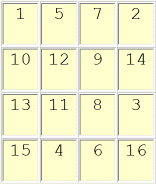
the shortest "A-path" has value 48, and the shortest "B-path" has value 51, so A won.
Features of the game: This game, very simple in its design and rules (16 cells, 16 "pawns", 20 paths per player), leads nonetheless to a surprising complexity: 400 million billion billion possible games. It displays the characteristics demanded from a good game: simplicity of rules, necessity to think, unexpected flips of situation, limited duration, unknown (so far*) optimal strategy to surely win.
Copyright : André Cabannes (patents INPI & OMPI, 1998)
* In 2015, it was proved that A wins all the time, if he plays well.